Sulfate Family
Selenite
About Selenite
Selenite is the crystalline, satin-white variety of gypsum, named for the Greek goddess of the moon (Selene) in honour of its soft, luminous glow. Its defining feature is a fibrous, optical sheen — light travels along the parallel crystal fibres, producing the same shifting, silky luminescence as a moonlit surface. It is one of the most ethereally beautiful of all decorative minerals.
Formation & Origin
Selenite forms by the slow evaporation of mineral-rich water, leaving behind layered gypsum crystals. The finest fibrous “satin spar” selenite comes from Morocco; Mexico’s Naica caves famously produced selenite crystals metres in length. Madagascar and the United States are other notable sources. Because it grows in soft, layered fibres, selenite is prized for visual effect rather than structural strength.
Why Selenite for Interiors
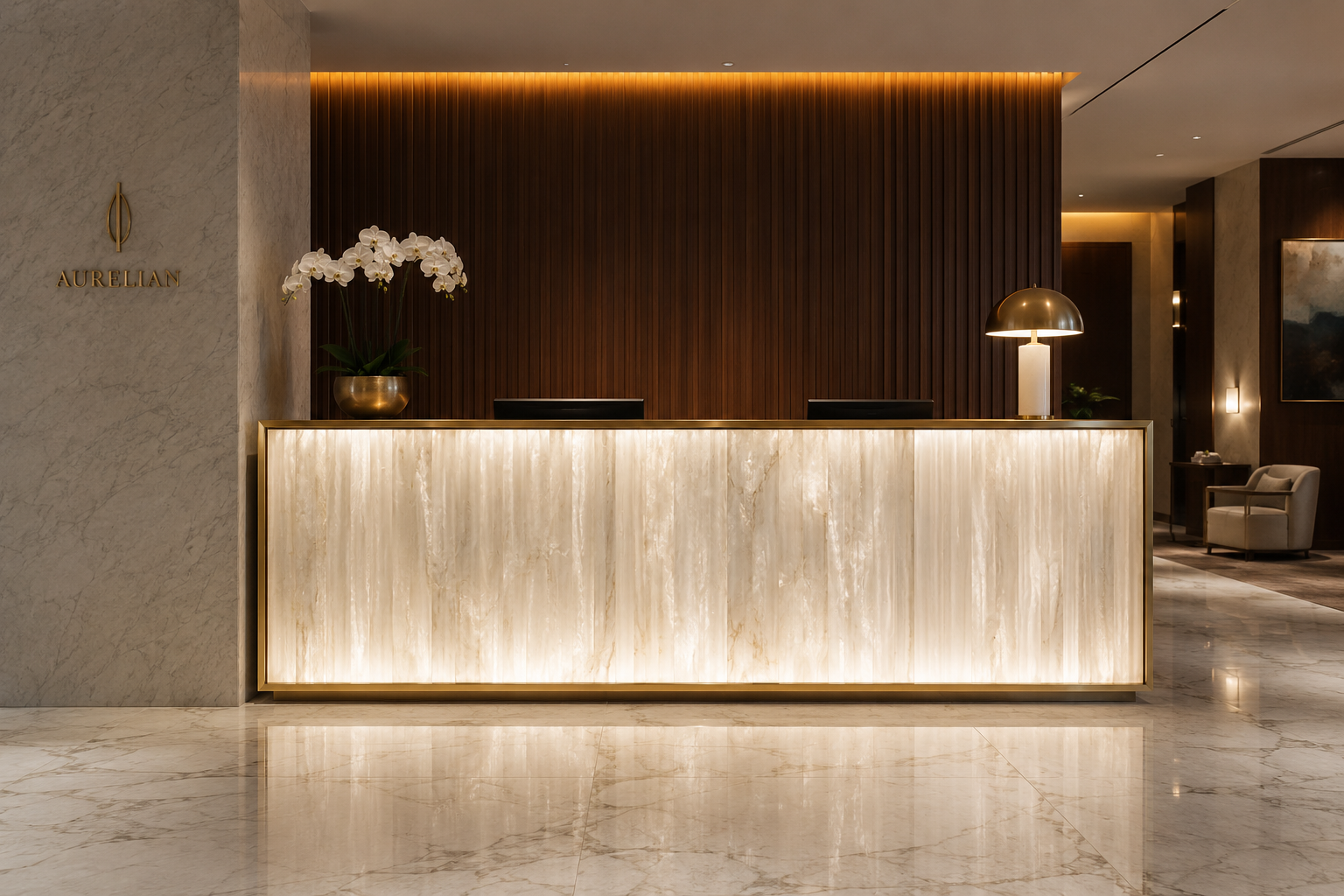
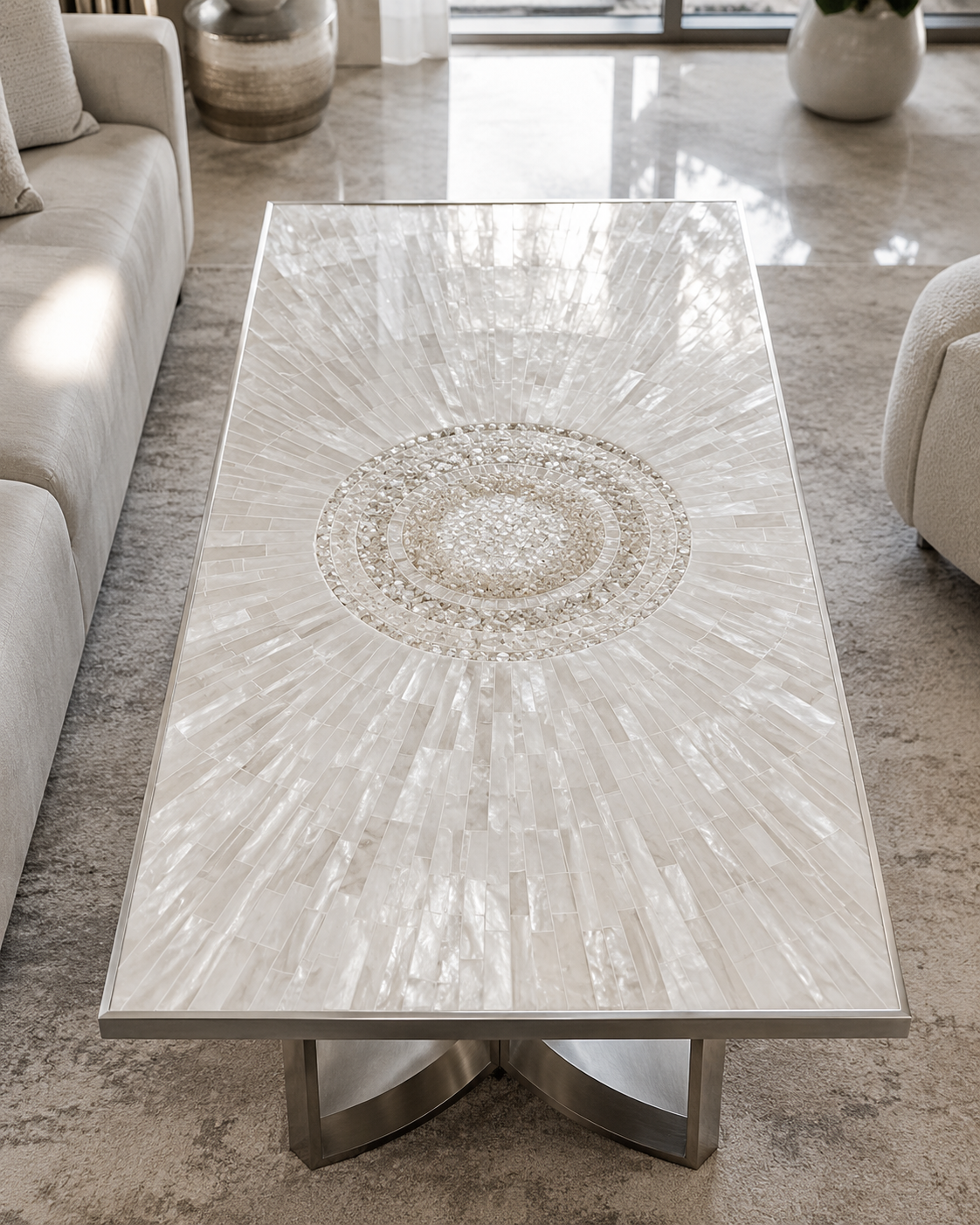
Selenite is the softest stone in the Gemvera library — Mohs 2 — and, unusually, it is slightly soluble in water. On its own it cannot survive as a working surface. We therefore use it only in encapsulated form: cut into thin tiles and inlay, assembled into mosaic patterns on a rigid backer, and sealed beneath low-iron tempered glass or a clear protective layer. In this construction the glass becomes the durable, wipe-clean surface, while the selenite glows untouched beneath it — especially when backlit, where it radiates a soft, alabaster-like light. The result is a piece that is both extraordinary to look at and genuinely livable. We are transparent about this: selenite belongs in statement furniture and feature panels, never in bare countertops or wet, cut applications.
Metaphysical Properties
Across traditions, selenite is regarded as a stone of light, clarity, and cleansing — associated with calm, mental clarity, and the crown chakra. It is one of the few crystals believed to cleanse and recharge other stones without itself needing cleansing. Whatever one’s view of these associations, the stone’s serene, moonlit presence makes it a natural centrepiece for spaces designed for stillness.
Applications
Available in Selenite
Care & Maintenance
Selenite is a soft, water-soluble mineral (Mohs 2). Gemvera uses it only in encapsulated form — as mosaic or inlay sealed beneath low-iron tempered glass or a clear protective layer. Clean only the protective surface with a soft, dry or barely-damp cloth. Never expose raw selenite to water, steam, or abrasion. Not suitable for bare countertops, wet zones, or field-cut surfaces.